

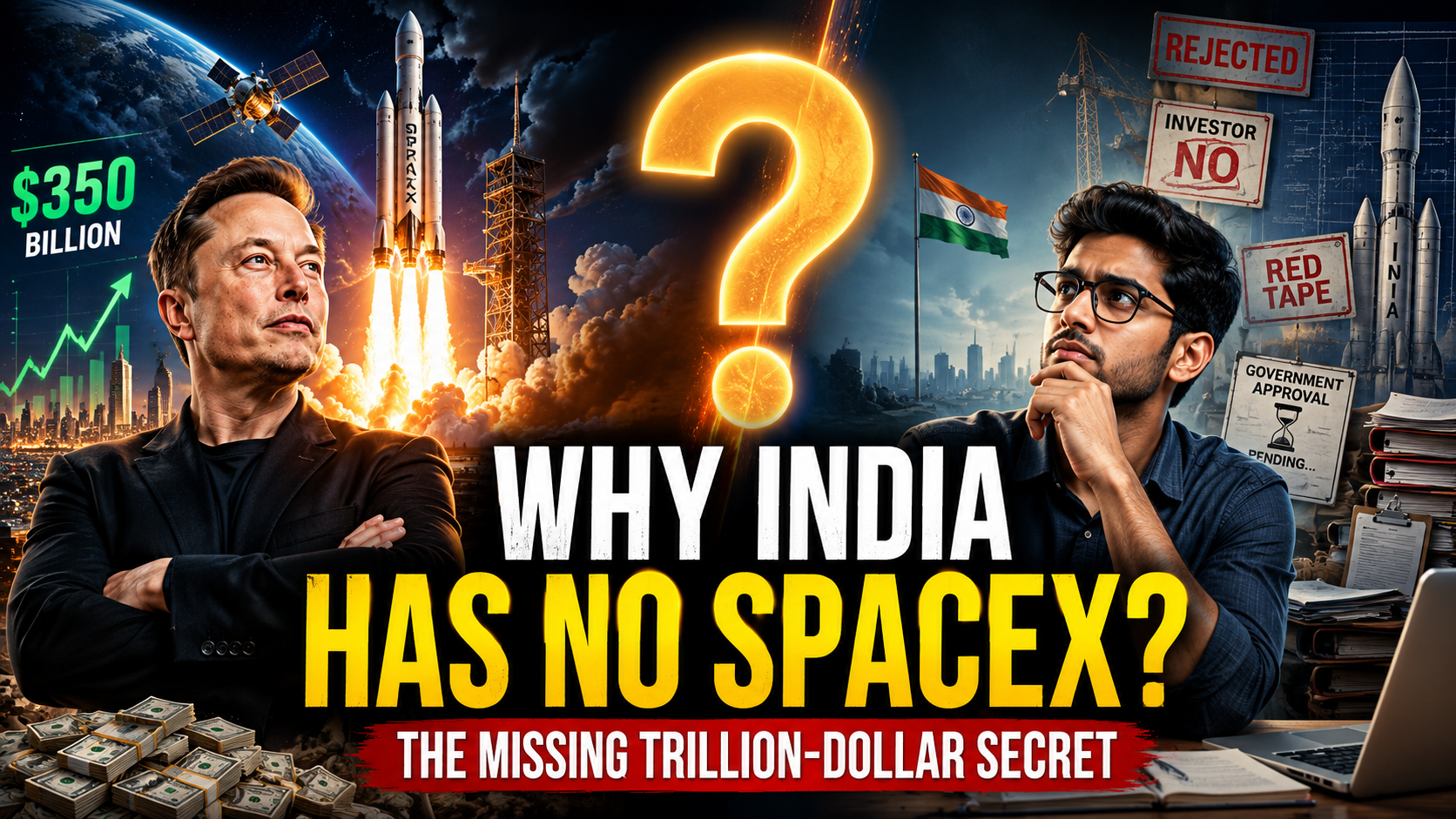
A little over two decades ago, a relatively unknown entrepreneur named Elon Musk made a series of bets that many considered irrational. Fast forward to 2026, and Musk has become one of the most influential business figures in modern history. At various points, his net worth exceeded $400 billion, making him the richest person on Earth. Analysts at several investment firms have even speculated that he could become the world’s first trillionaire if the valuations of his companies continue to compound. His flagship space venture, SpaceX, is now valued at approximately $350 billion—more than twice Pakistan’s GDP of roughly $170 billion. What makes this achievement even more remarkable is that SpaceX was founded in 2002 with little more than an audacious dream: making humanity a multi-planetary species.
The obvious question for India is this: why does a phenomenon like Elon Musk emerge in America but not in India? Why has a nation of 1.4 billion people, with some of the world’s finest engineers and one of the fastest-growing startup ecosystems, not produced a company comparable to SpaceX? To answer that question, we must first understand the extraordinary journey of SpaceX itself.
When Space Exploration Was a Government Monopoly
When Elon Musk founded SpaceX in 2002, the global space industry looked very different. Rocket launches were dominated by national agencies such as NASA, Roscosmos, and the European Space Agency. Private companies were largely confined to supplying components and equipment. The notion that a private startup could design, manufacture, and launch orbital rockets seemed almost laughable.
Musk believed the industry suffered from a fundamental inefficiency. Rockets costing tens or hundreds of millions of dollars were being discarded after a single use. His argument was simple: if commercial airlines threw away aircraft after every flight, air travel would be prohibitively expensive. Why should rockets be any different?
The industry dismissed the idea. Investors remained skeptical. Aerospace experts questioned whether a newcomer could survive in one of the most technically demanding industries on the planet.
Three Failures Away from Oblivion
Between 2006 and 2008, SpaceX attempted three launches of its Falcon 1 rocket. All three failed. By the summer of 2008, the company was nearly bankrupt. Musk had invested more than $100 million of his personal fortune into SpaceX while simultaneously struggling to keep Tesla alive during the global financial crisis.
The situation became so desperate that a fourth launch failure would likely have ended the company forever.
Then came September 28, 2008.
The fourth Falcon 1 launch succeeded, making SpaceX the first privately funded company in history to send a liquid-fueled rocket into orbit. A few months later, NASA awarded SpaceX a $1.6 billion Commercial Resupply Services contract. That single contract transformed SpaceX from a struggling startup into a credible aerospace company.
History often appears inevitable in hindsight. In reality, the difference between failure and success sometimes comes down to a single launch.
Building the World’s Most Valuable Private Company
Over the next decade, SpaceX achieved what many experts had considered impossible. In December 2015, it successfully landed a Falcon 9 rocket vertically after launch. In March 2017, it re-launched a previously flown orbital rocket, proving that reusability was commercially viable.
The economic impact was revolutionary. Traditional launch providers often charged more than $20,000 per kilogram to send payloads into orbit. SpaceX dramatically reduced those costs, making space accessible to a broader range of customers.
By 2026, the company had completed hundreds of successful launches and established itself as the dominant player in the global launch market. Meanwhile, Starlink, its satellite internet business, deployed more than 7,000 satellites and generated billions of dollars in annual revenue. Private funding rounds valued SpaceX at roughly $350 billion, making it one of the most valuable private companies ever created.
What is remarkable is that SpaceX reached this scale without going public. If and when an IPO eventually occurs, it could become one of the largest public offerings in financial history.
The Secret Ingredient: Patient Capital
The SpaceX story is often presented as a tale of engineering genius. In reality, it is equally a story about capital allocation.
For nearly two decades, investors continued supporting a company that consistently reinvested cash into long-term projects. Conventional valuation metrics offered limited comfort. There were years when profitability appeared distant and risks seemed overwhelming.
Yet investors remained willing to fund the vision.
This is one of America’s greatest competitive advantages. Its venture capital ecosystem is capable of financing projects that may require ten or twenty years to generate extraordinary returns. According to industry estimates, American venture capital firms invested more than $170 billion annually during peak funding years. This ecosystem creates the financial foundation necessary for moonshot ventures.
SpaceX did not merely receive funding. It received patient funding.
That distinction matters.
India’s Success Story—and Its Limitation
India has unquestionably produced world-class companies. Firms in information technology, pharmaceuticals, banking, and telecommunications have generated enormous shareholder wealth. India’s stock market capitalization has crossed $5 trillion, making it one of the largest capital markets in the world.
However, most Indian corporate success stories share a common characteristic: they excel at execution rather than disruption.
Historically, Indian businesses have thrived by optimizing existing business models, improving operational efficiency, and scaling proven concepts. This approach has produced remarkable outcomes, but it rarely creates companies that redefine entire industries.
The roots of this phenomenon are historical. For decades after independence, India operated in a capital-scarce environment. Entrepreneurs learned to prioritize survival. Investors focused on profitability. Banks preferred collateral-backed lending. Risk-taking was often discouraged rather than rewarded.
These habits do not disappear overnight.
The Cost of Being Afraid to Fail
Perhaps the most important difference between Silicon Valley and India is cultural.
In the United States, entrepreneurial failure is often considered a learning experience. Investors frequently back founders who have previously failed because they are perceived as battle-tested.
In India, failure still carries significant social and financial consequences. A failed entrepreneur may face skepticism from investors, family members, lenders, and even future employees.
The result is predictable. Founders gravitate toward safer opportunities. Investors prefer proven business models. Ambitious projects struggle to secure capital.
Yet every transformational company begins as an uncertain experiment. Amazon spent years reporting losses. Tesla nearly collapsed during the 2008 financial crisis. SpaceX survived by the narrowest of margins.
Innovation requires a society willing to tolerate failure.
Signs That India Is Changing
Despite these challenges, India’s innovation ecosystem is evolving rapidly. Startup funding, though cyclical, has created a generation of founders willing to pursue larger ambitions. The emergence of companies in electric vehicles, semiconductor manufacturing, artificial intelligence, defense technology, and private space exploration suggests that India is entering a new phase of entrepreneurial development.
The country’s private space sector, in particular, offers reason for optimism. Following the success of ISRO, Indian startups are increasingly entering launch services, satellite manufacturing, and space technology. While none currently rival SpaceX in scale, they represent the beginnings of an ecosystem that did not exist a decade ago.
The Real Lesson from SpaceX
The lesson from SpaceX is not that India needs an Elon Musk. Nations do not become innovation powerhouses because of one extraordinary individual.
They become innovation powerhouses because they create systems that repeatedly produce extraordinary individuals.
India already possesses the raw ingredients: talent, engineering capability, a massive domestic market, and growing pools of capital. What remains in short supply is institutional support for seemingly impossible ideas.
The next trillion-dollar company will probably not emerge from improving yesterday’s business models. It will emerge from solving problems that most people currently regard as impossible.
That is exactly how SpaceX began in 2002.
And perhaps, one day, that is how India’s own SpaceX story will begin.