

A Currency Under Pressure, A Central Bank Under Test
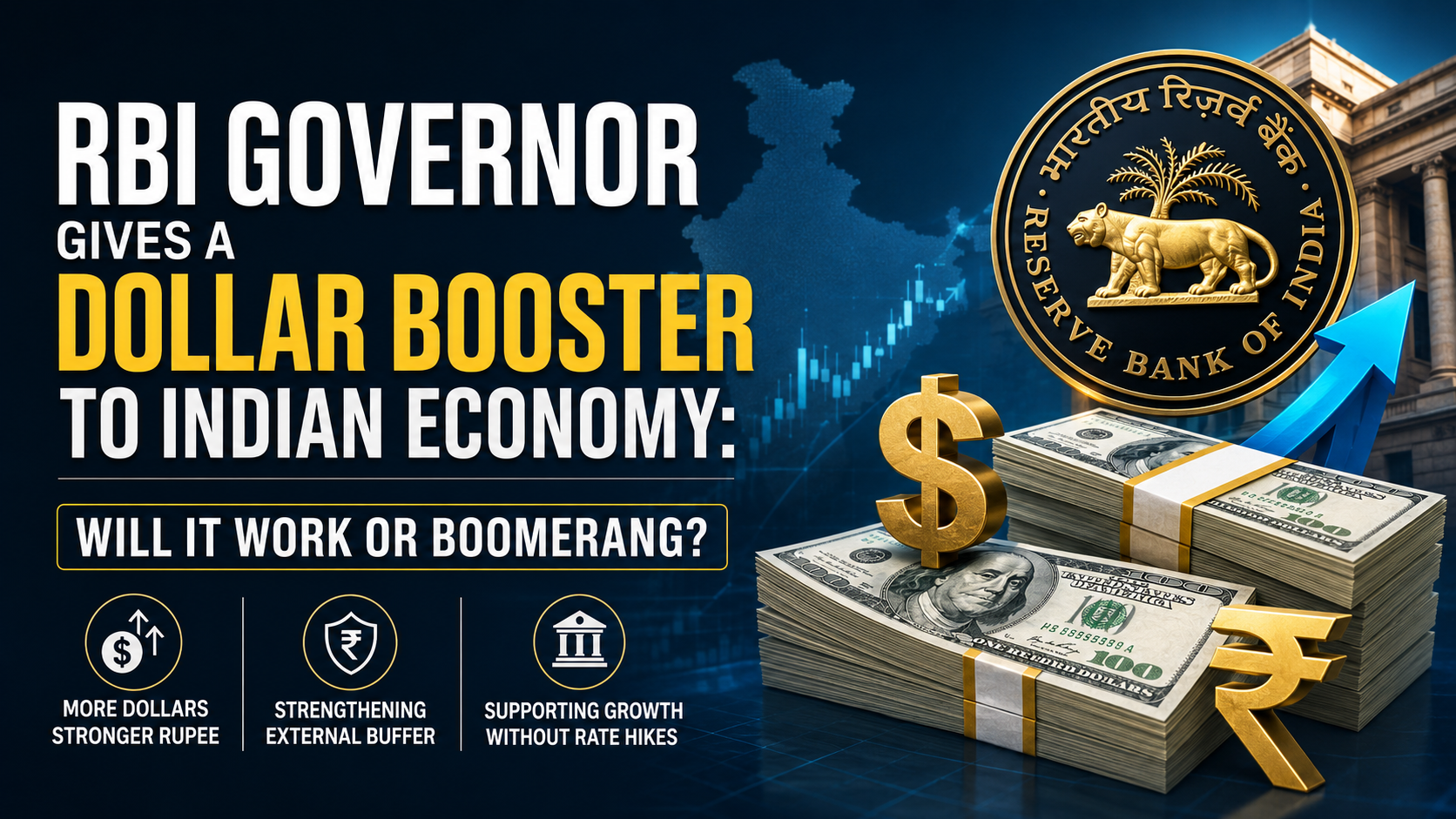
When a currency begins to weaken, central banks often find themselves cornered. Raising interest rates can support the currency but may hurt economic growth. Allowing the currency to depreciate can fuel inflation and shake investor confidence. In its June 2026 monetary policy, the Reserve Bank of India attempted to navigate this difficult trade-off through an unconventional route. Rather than tightening monetary conditions, RBI Governor Sanjay Malhotra chose to attract more dollars into the country.
The headline announcement was significant. The RBI will bear the entire hedging cost for banks mobilising fresh FCNR(B) deposits until September 30, 2026. Alongside this, the central bank unveiled concessional forex swap facilities and eased certain norms relating to foreign capital inflows. Collectively, these measures are aimed at strengthening India’s external position, supporting the rupee and ensuring adequate foreign currency liquidity in the financial system.
The announcement immediately raised an important question. Is this a clever policy intervention that can strengthen India’s economic resilience, or is it merely borrowing time that could create new risks in the future?
Why RBI Suddenly Needs More Dollars
The answer lies in the changing global environment. Over the past few months, the Indian rupee has come under increasing pressure from a combination of external factors. Rising crude oil prices have widened concerns about India’s import bill, geopolitical tensions in West Asia have increased uncertainty in global markets, and foreign investors have shown a preference for the safety of dollar-denominated assets.
Ordinarily, a central bank facing such pressures might consider raising interest rates to make domestic assets more attractive. However, India’s economic situation does not lend itself easily to that option. Growth concerns continue to linger, and higher borrowing costs could dampen investment and consumption. The RBI therefore appears to have concluded that attracting foreign currency inflows would be less damaging than tightening domestic financial conditions.
This is where FCNR(B) deposits enter the picture.
The Return of the FCNR(B) Playbook
FCNR(B), or Foreign Currency Non-Resident Bank deposits, are a familiar instrument in India’s financial architecture. These deposits allow Non-Resident Indians to place money with Indian banks in foreign currencies such as US dollars, pounds or euros. Since both principal and interest are repaid in the same foreign currency, the depositor is protected from fluctuations in the rupee.
The currency risk instead falls on the bank. To manage this risk, banks hedge their foreign currency exposure in the market. During periods of currency volatility, however, hedging costs can rise substantially, reducing the attractiveness of mobilising such deposits.
By agreeing to absorb the entire hedging cost, the RBI has effectively removed a major obstacle for banks. The incentive is clear: raise more foreign currency deposits, bring more dollars into India and strengthen the country’s external balance sheet.
The move inevitably draws comparisons with 2013, when the RBI under Governor Raghuram Rajan used a similar FCNR(B)-based strategy to counter the turbulence created by the US Federal Reserve’s taper tantrum. That initiative attracted tens of billions of dollars and helped stabilize both the rupee and market sentiment. The latest announcement suggests that policymakers still view FCNR(B) deposits as an effective tool during periods of external stress.
The Immediate Benefits Could Be Meaningful
The most obvious benefit is the potential increase in dollar inflows. For a country that remains heavily dependent on imported energy, access to foreign currency is always strategically important. Additional inflows can reduce pressure on the rupee and provide reassurance to markets that India possesses adequate external buffers.
Equally important is the signal being sent to investors. The RBI’s decision demonstrates a willingness to act proactively rather than reactively. Instead of waiting for the rupee to come under severe pressure, the central bank is attempting to build additional resilience while market conditions remain manageable.
There is also a broader policy advantage. By attracting dollars directly, the RBI can support the currency without raising domestic interest rates. This preserves room for economic growth at a time when policymakers are trying to strike a delicate balance between inflation control and economic expansion.
For banks, the measure creates an opportunity to expand their foreign currency liabilities without bearing the associated hedging burden. For NRIs, it may result in more attractive deposit offerings. For the broader economy, it provides a potentially valuable source of foreign exchange at a time when global capital flows remain unpredictable.
But Every Dollar Has a Cost
While the benefits are immediate and visible, the risks are less obvious but equally important.
The first concern is that FCNR(B) deposits are not permanent capital. They are liabilities that must eventually be repaid. The dollars entering India today could leave tomorrow when the deposits mature. This was precisely one of the concerns that emerged after the 2013 FCNR(B) mobilization program. Although the scheme successfully attracted large inflows, policymakers later had to manage the maturity profile of those deposits carefully to prevent market disruptions.
The second concern relates to the cost being absorbed by the central bank. Hedging foreign currency risk is not free. By taking this burden upon itself, the RBI is effectively subsidizing the mobilization of foreign currency deposits. If exchange-rate volatility remains elevated, the cumulative cost of these hedges could become substantial.
There is also the question of quality. Not all foreign inflows contribute equally to economic development. Foreign Direct Investment creates productive assets, generates employment and contributes to long-term economic growth. FCNR(B) deposits, while useful for strengthening reserves and improving liquidity, do not create factories or infrastructure. They help manage financial stability, but they do not necessarily enhance productive capacity.
This distinction is important because temporary capital inflows can never substitute for structural improvements in competitiveness, exports and investment attractiveness.
Is RBI Solving a Problem That Doesn’t Yet Exist?
Interestingly, India is not currently facing an external-sector crisis. Foreign exchange reserves remain comfortably above $680 billion, providing one of the strongest reserve cushions in the country’s history. The current account position, while vulnerable to oil prices, remains manageable by historical standards.
This suggests that the RBI’s latest intervention is fundamentally preventive rather than defensive. The central bank is not responding to a crisis. It is attempting to ensure that one does not emerge.
Such pre-emptive policymaking often proves more effective than emergency responses. Markets generally reward institutions that act before vulnerabilities become threats. From that perspective, the RBI’s decision can be viewed as an insurance policy rather than a rescue package.
The Fingineer View
The RBI’s latest dollar-boosting measures appear to be a smart tactical response to an increasingly uncertain global environment. They strengthen external liquidity, support the rupee and preserve the central bank’s ability to support economic growth without resorting to higher interest rates.
Yet the long-term verdict will depend on how these inflows are utilised. If the additional dollars simply buy time while underlying vulnerabilities persist, the policy may eventually resemble a temporary patch. If, however, the breathing space created by these measures is used to strengthen exports, improve investment flows and enhance economic competitiveness, the initiative could prove highly effective.
For now, Governor Sanjay Malhotra has chosen a middle path between defending the rupee and protecting growth. Markets seem willing to give him the benefit of the doubt. Whether this dollar booster becomes a lasting success or an expensive boomerang will depend not on the dollars that arrive over the next few months, but on the strength of the economy when those dollars eventually decide to leave.