

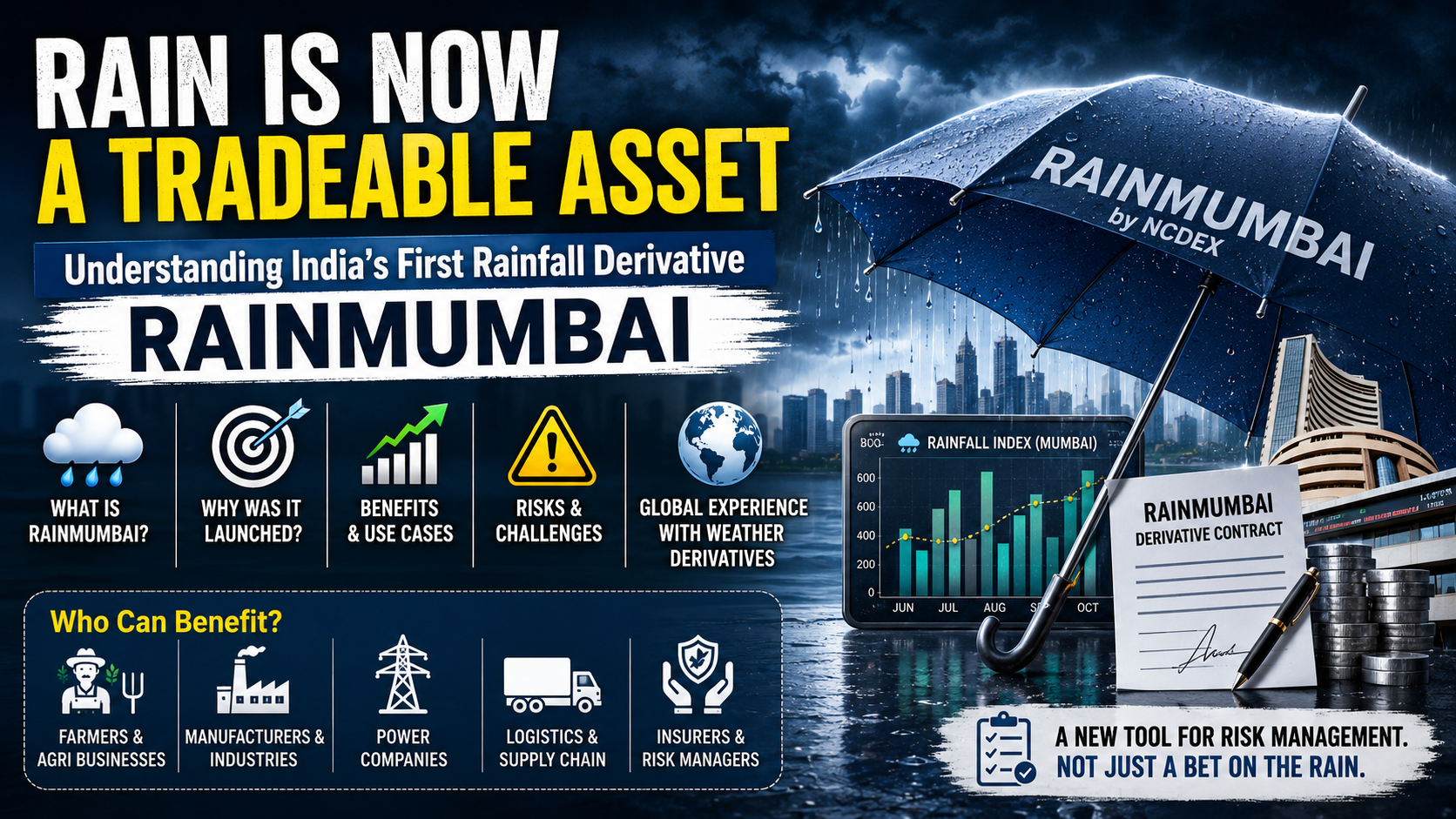
As if the existing futures contracts were not enough to lure retail investors into increasingly complex bets, the regulator has now approved one more futures contract—one that allows market participants to take positions on rainfall itself.
Welcome to RAINMUMBAI, India’s first exchange-traded rainfall derivative contract launched on the National Commodity & Derivatives Exchange (NCDEX). In a country where the monsoon influences everything from farm output and food inflation to power generation and GDP growth, the idea may sound logical. Yet, for many investors, it also raises an obvious question: Are we creating a useful risk-management tool or simply inventing a new playground for speculation?
This article attempts to dive deep into the RAINMUMBAI contract, its rationale, potential benefits, drawbacks, global experience, and what small investors should know before getting involved.
What Exactly Is a Rainfall Derivative?
At first glance, the concept sounds bizarre. How can one trade rainfall?
The answer lies in understanding what a derivative is. A derivative derives its value from an underlying variable. In stock futures, the underlying is a stock. In crude oil futures, it is crude oil. In rainfall derivatives, the underlying is a weather parameter—in this case, rainfall recorded in Mumbai.
Participants are not buying or selling rain. Instead, they are trading contracts whose payouts depend on whether actual rainfall exceeds or falls short of predetermined benchmarks.
The settlement is based on objective rainfall data collected from designated weather stations. Therefore, the contract becomes a financial instrument linked to weather outcomes rather than a physical commodity.
Why Has NCDEX Launched It?
India remains one of the world’s most monsoon-dependent economies.
A weak monsoon can damage crops, reduce rural incomes, increase food inflation, and affect economic growth. Excessive rainfall can be equally destructive, causing floods, infrastructure damage, and supply-chain disruptions.
Many businesses face direct financial exposure to weather conditions. These include:
- Agricultural producers
- Food processing companies
- Fertilizer manufacturers
- Power utilities
- Construction firms
- Logistics companies
- Commodity traders
Traditionally, such entities had limited options to hedge weather-related risks. Insurance products exist, but they are often expensive, restrictive, or available only after losses occur.
A rainfall derivative offers a market-based mechanism to transfer and manage weather risk before the damage occurs. In theory, it allows businesses to offset losses arising from adverse rainfall patterns.
The Potential Benefits
The strongest argument in favour of rainfall derivatives is risk management.
Consider a seed company expecting lower sales if rainfall is deficient. By taking an appropriate position in a rainfall derivative, the company could potentially offset part of its business losses if rainfall turns out to be lower than expected.
Similarly, power companies dependent on hydropower generation can use weather-linked contracts to manage revenue volatility.
Another benefit is price discovery. Financial markets often aggregate information from thousands of participants. A rainfall derivative market could create an implied market expectation regarding monsoon conditions, providing useful signals to businesses and policymakers.
The contract may also encourage innovation in weather-risk management. Climate change is making weather patterns increasingly unpredictable. Financial instruments linked to weather variables may become more relevant in the coming decades.
Finally, the launch signals the maturation of Indian commodity markets. Advanced economies have long experimented with weather-linked financial products. India’s entry into this space reflects growing sophistication in market design.
The Risks and Disadvantages
Despite the theoretical benefits, rainfall derivatives come with significant concerns.
The first is complexity.
Most retail investors struggle to understand equity derivatives, options strategies, and commodity futures. Weather derivatives introduce another layer of complexity involving meteorology, statistical modelling, and probability analysis.
The second concern is speculative excess.
Many market participants may enter these contracts not for hedging but for gambling on weather forecasts. When speculative interest overwhelms genuine hedging demand, derivatives can become detached from their original purpose.
Liquidity is another challenge. A derivative contract is useful only if there are enough buyers and sellers. Since rainfall derivatives are new to India, it remains uncertain whether sufficient trading volume will emerge.
There is also what experts call “basis risk.” A farmer or business may suffer losses due to local weather conditions while the contract settlement depends on rainfall measured at a designated weather station. The hedge may therefore be imperfect.
Finally, weather forecasting itself is far from perfect. Even sophisticated meteorological agencies frequently revise rainfall estimates. Trading based on uncertain forecasts can produce substantial losses.
Has the World Tried This Before?
Yes.
Weather derivatives are not a new invention.
The first organised weather derivative market emerged in the United States during the late 1990s. Energy companies initially used temperature-based contracts to hedge against unusually warm winters or cool summers that affected electricity demand.
The most prominent marketplace was the futures exchange operated by the Chicago Mercantile Exchange (CME), which introduced weather futures and options linked to temperature indexes.
Over time, contracts based on temperature, snowfall, frost, and rainfall were introduced in various forms.
The experience, however, has been mixed.
Weather derivatives found niche acceptance among energy companies, utilities, insurers, and specialised risk managers. They never became mainstream retail products.
One major challenge was liquidity. Many contracts struggled to attract sufficient participation. As a result, weather-risk management globally remains dominated by specialised institutional participants rather than ordinary investors.
This experience offers an important lesson for India. The success of RAINMUMBAI will depend not merely on its launch but on whether genuine hedgers and liquidity providers actively use the product.
How Can Investors Participate?
Participation is relatively straightforward from an operational perspective.
Investors need:
- A demat account
- A commodity trading account
- Access to an NCDEX-authorised broker
- Sufficient margin money
Once the contract is available on the trading platform, investors can buy or sell positions just as they would in other futures contracts.
The simplicity of execution, however, should not be confused with simplicity of understanding.
Trading a rainfall derivative requires knowledge of contract specifications, settlement methodology, rainfall benchmarks, and weather dynamics.
A Message to Small Investors
The arrival of RAINMUMBAI is undoubtedly an important milestone for Indian financial markets. It demonstrates innovation and recognizes the growing economic importance of climate-related risks.
However, small investors should resist the temptation to view it as an easy money-making opportunity.
A rainfall derivative is not a magical shortcut to profits. It is a specialized risk-management instrument. Even in developed markets, such products are primarily used by institutions with deep expertise and clear hedging needs.
Before taking any position, investors should ask themselves a simple question: “Do I genuinely understand the factors that drive this contract?”
If the answer is no, observation may be wiser than participation.
Financial history is full of products that were introduced as sophisticated tools but eventually became vehicles for speculation. Whether RAINMUMBAI becomes a useful instrument for managing climate risk or another speculative battleground will depend not only on regulators and exchanges but also on the discipline of market participants themselves.
For now, India’s financial markets have entered a new era—one where even the monsoon can be traded.