

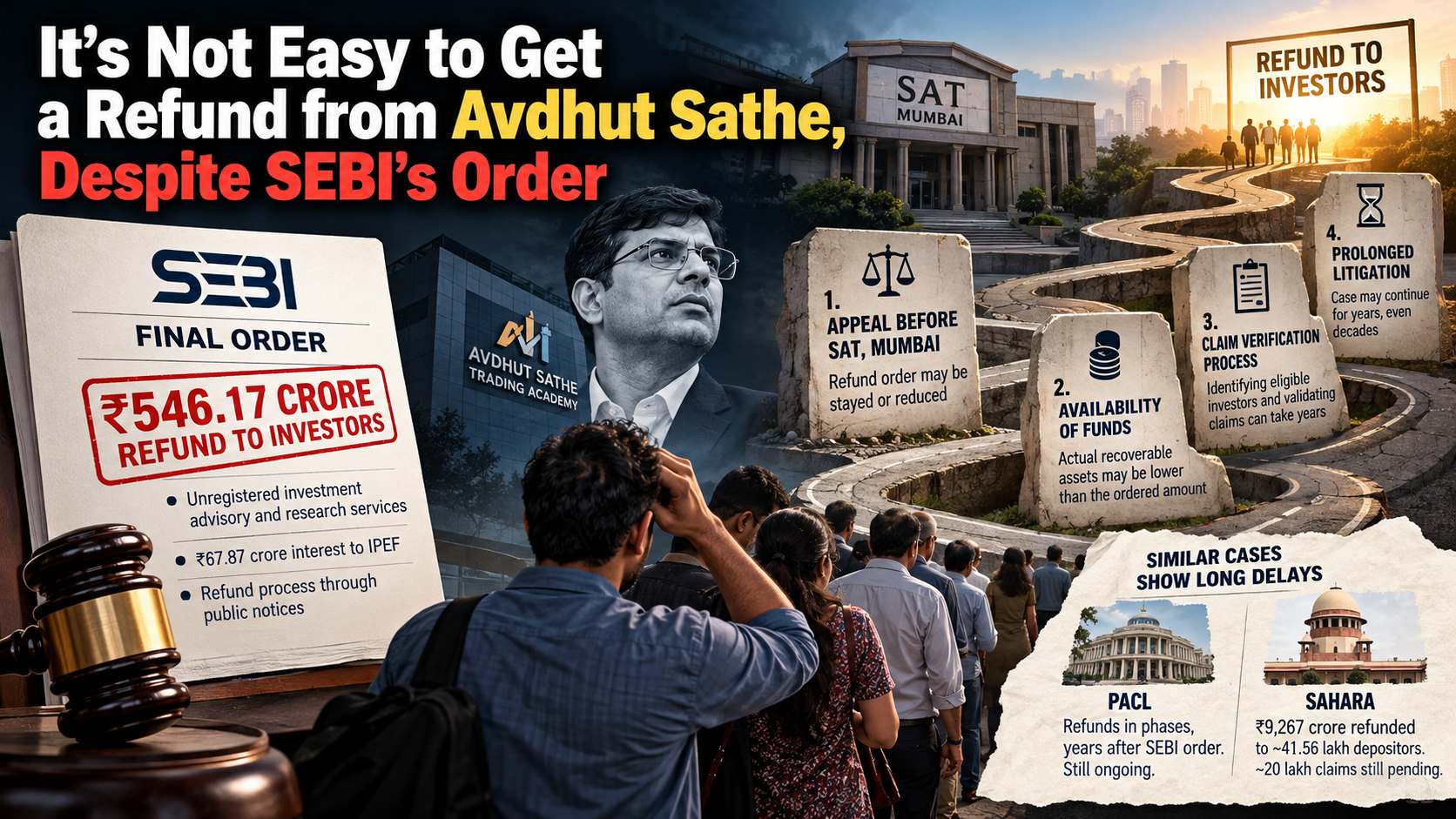
SEBI’s ₹546.17-crore refund order against Avadhut Sathe Trading Academy may be a victory for investor protection on paper. But the journey from a regulatory direction to money actually reaching investors could be long, complicated and uncertain.
The Securities and Exchange Board of India (SEBI) has ordered Avadhut Sathe Trading Academy Pvt. Ltd. (ASTA) and its founder, Avadhut Sathe, to refund ₹546.17 crore collected through activities that the regulator found amounted to unregistered investment advisory and research services. It has also directed them to deposit ₹67.87 crore as interest with SEBI’s Investor Protection and Education Fund. Eligible investors and participants are to be informed about the refund process through public notices.
The order sounds decisive. However, ordering a refund and ensuring that investors receive it are two very different things. The real test begins if the findings and financial directions are challenged before the Securities Appellate Tribunal (SAT), Mumbai.
The first hurdle: Can the refund order be stayed?
The financial direction is likely to be a central point of contention. SEBI has attributed ₹546.17 crore in programme fees to unregistered advisory and research activities. ASTA has maintained that its programmes were educational. A key legal question is whether the entire fee collected from the identified programmes can be treated as attributable to unlawful services when the programmes also contained educational material.
SEBI has rejected this distinction, reasoning that actionable securities recommendations were integral to the programmes. Nevertheless, the academy could challenge the attribution methodology, the treatment of different courses and the basis for quantifying the amount recoverable. The final outcome will depend on the evidence and the tribunal’s assessment—not merely on the fact that the order has been passed.
If SAT grants a stay of the refund direction, or modifies the amount that must be secured, the immediate refund process could be delayed. A stay is not automatic simply because an appeal is filed; nor does a successful challenge to one part of the order necessarily invalidate the entire order. But prolonged appellate proceedings could leave investors waiting while the legal dispute continues.
There is a precedent for how quickly the financial consequences of this case can become contested. In January 2026, SAT, while dealing with an earlier appeal against SEBI’s interim order, directed ASTA and Sathe to deposit ₹100 crore and disclose their assets, instead of requiring the entire ₹546 crore to be secured at that stage. The tribunal expressly left the final merits open. That was an interim-stage decision, not a ruling on the final order dated October 23, 2026. Still, it demonstrates why investors should not assume that a large amount mentioned in a SEBI order will immediately be available for distribution.
The second hurdle: Where is the money?
A refund order cannot create money that is no longer available. The academy’s earlier submissions in the interim proceedings disputed the availability of the full amount and referred to taxes, operating expenses and fixed assets. These were the appellants’ contentions, not a final judicial determination that the money is irrecoverable. Nevertheless, they raise the crucial practical question: how much can actually be recovered in cash, and how much would require the realisation of assets or further legal proceedings?
SEBI’s restrictions on debits and the sale of assets are intended to protect recoverable funds. Their effectiveness will depend on the assets available, their valuation, existing liabilities and the final directions of the appellate forum. If the academy cannot deposit the amount within the prescribed period, enforcement and asset-recovery disputes could add another layer of delay.
PACL and Sahara offer a sobering lesson
Investors have seen how complicated large-scale refund exercises can become, even when regulatory or court-supervised mechanisms are in place. In the PACL matter, SEBI’s Lodha Committee has been processing claims in phases, verifying applications and using proceeds from property sales to fund refunds. Its official portal reported that by September 2026, approximately 37.41 lakh eligible applications had received refunds totalling ₹4,005.72 crore—years after the refund process began.
The Sahara cooperative societies’ refund process provides another example. The Union government reported in September 2026 that ₹9,267 crore had been refunded to around 41.56 lakh depositors, while approximately 20 lakh applications were still awaiting processing. Verification, documentation and administrative constraints have all affected the process.
These cases are not legally identical to ASTA. PACL involved property realisation and a committee-supervised refund process; Sahara involves cooperative deposits and a separate court-supervised mechanism. Their relevance lies in the practical lesson: a refund framework can exist for years without every claimant receiving money promptly.
A long road ahead for investors?
The October 23 order gives ASTA and Sathe five months from receipt of the order to deposit the specified refund amount into a dedicated account, with further directions governing claims and any unclaimed balance. But the timeline could become difficult to predict if the financial directions are stayed, reduced or challenged through further appeals.
Investors should therefore distinguish between a regulatory victory and a completed recovery. Until the order survives appellate scrutiny, sufficient funds are secured and a workable claim-verification process begins, the ₹546.17-crore figure remains an amount directed to be refunded—not money already credited to investors.
If the dispute moves through successive rounds of litigation, the process could stretch for years; in a worst-case scenario involving prolonged appeals and enforcement disputes, investors could face a wait measured in decades. That is a risk, not a prediction that this particular case will necessarily last that long.
SEBI has taken a significant step by issuing its final order. The real measure of success, however, will be the amount ultimately recovered and the speed with which eligible claimants receive it. For investors, the battle may have moved from establishing wrongdoing to securing their money.