

Indian equities have always lived with “global risk-on/risk-off” swings, but the last six months have underlined a sharper reality: single-source political communication—especially Donald Trump’s Truth Social posts and follow-up remarks—can reprice Indian risk within minutes, even when the policy details are unclear.
This article tracks Trump’s most market-relevant statements in the last six months, what D- Street did around those shocks, how much market capitalization was erased on key days, and how investors can hedge the Trump uncertainty.
Why Trump statements matter to Dalal Street
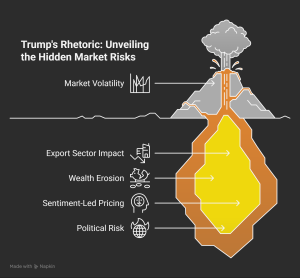
Trump’s market impact comes from policy optionality—posts often function as trial balloons that raise the probability of adverse outcomes (tariffs, penalties, sanctions, supply-chain disruption) before details are known. For India, three transmission channels dominate:
-
- Export earnings risk (textiles, auto components, chemicals, pharma, gems & jewellery).
- USD/INR and oil (trade-war risk can strengthen USD and lift oil risk premium; India is a net importer).
- FPI flows and volatility (uncertainty widens risk premia; India VIX tends to spike during tariff headlines).
Trump’s statements in the last SIX months that moved India-linked risk
Let us examine the trade-tariff related statements made by Donald Trump over the last six months, assess their implications for Indian financial markets, and correlate them with D- Street movement.
Event A — July 7, 2025: BRICS threat
In a Truth Social post carried widely by global media, Trump warned:
“Any Country aligning themselves with the Anti-American policies of BRICS, will be charged an ADDITIONAL 10% Tariff….”
India is a BRICS member; even without immediate implementation clarity, the post raised the probability of India-US trade friction just as markets were positioned for a cooperative trade narrative.
Event B — July 30, 2025: India-specific tariff threat (Truth Social) → market selloff next day
Trump posted that India’s tariffs were “among the highest in the World,” with “obnoxious” trade barriers, and announced 25% tariffs on Indian goods, plus an unspecified “penalty” tied to Russian oil/arms and BRICS considerations. July 31, 2025, the very next day, Indian benchmarks fell sharply; one widely cited measure of investor wealth (BSE market capitalization) fell by ₹5.46 lakh crore versus the prior session.
Event C — Aug 6–7, 2025: escalation to “as high as 50%” duties
Reuters reported Trump imposed an additional 25% tariff citing India’s Russian oil imports, taking duties on some Indian exports up to 50% and deepening the trade shock. Markets whipsawed. Indian benchmarks recovered intraday on Aug 7 after early pressure as other geopolitical headlines helped sentiment.
Event E — Oct 6–7, 2025: heavy/medium-duty truck tariff
Trump announced a 25% tariff on imported medium- and heavy-duty trucks. Although, not an India-only tariff, but it raised global auto-supply-chain anxiety and contributed to caution in auto-linked trade narratives.
Event F — Jan 5–8, 2026: renewed tariff rhetoric tied to Russian oil and “500% bill” fears
Reuters reported Trump warned of higher tariffs on India if Russian oil purchases continue. On Jan 8, market reports recorded a sharp selloff with BSE-listed market cap erosion of more than ₹8 lakh crore in a single session amid broad risk-off and tariff anxiety.
What happened to Indian Indices around these statements
Rather than pretending every tick was “because Trump,” the honest framing is: Trump posts acted as catalysts—they amplified downside on already-fragile days and widened the distribution of outcomes.
- July 31, 2025 (post → next-day impact): Nifty and Sensex dropped around 0.6% after the tariff announcement.
- Aug 7, 2025 (escalation window): Early weakness after the doubling of tariffs, followed by a rebound to finish roughly flat.
- Jan 8, 2026 (renewed jitters): India’s benchmarks fell most in months amid tariff worries and broad sector declines.
The market’s first response is usually risk reduction (sell cyclicals / exporters, buy defensives, hedge FX). The second response depends on whether investors read the post as (a) a negotiating stance or (b) a near-certain policy action.
Market-cap erosion linked to key Trump-statement days
Below is a date-wise “capital erosion” view using reported market-cap loss figures from major outlets (not modelled estimates). Where the media cited “investor wealth erased,” that’s typically BSE total market capitalization change versus the prior close.
Date-wise chart (selected event days)
- 31 Jul 2025: Investor wealth down ₹5.46 lakh crore
- 26 Aug 2025: Investors lose ₹6 lakh crore ahead of 50% tariff effective window
- 08 Jan 2026: BSE-listed market cap erased >₹8 lakh crore
How to hedge Trump-driven uncertainty
When market volatility is driven by political statements rather than economic data, traditional forecasting loses its edge. Trump-related tariff rhetoric has shown that uncertainty itself can become the primary risk factor. In such an environment, investors are better served by preparedness than prediction—using disciplined hedging strategies to protect portfolios from sudden sentiment-driven swings. You’re hedging gap risk (overnight headline shocks) and volatility expansion.
Index protection (most direct)
Buy protective puts on Nifty (or put spreads to reduce premium). Best when India VIX is not already spiking. Adopt Collar strategy (buy put, sell OTM call). Useful for long-only portfolios willing to cap upside.
Volatility as Hedge
When Trump/tariff noise rises, volatility often lifts.
You can express this through options structures (long gamma) rather than directional bets.
Sector hedges (target the transmission channel)
If the shock is US demand / trade, hedge with short exposure (or put spreads) on IT Index, crude linked instrument or defensives.
Currency-aware hedging (underrated)
Trade shocks often pressure INR. If your portfolio has USD-linked revenue exposure (IT), INR weakness can partially offset equity damage; for INR-cost-heavy businesses, it can worsen it. Consider USDINR hedges if your investment constraints allow.
“Rules-based” risk control
Because the trigger is unpredictable, use rules: reduce gross exposure when India VIX breaks above a chosen threshold. Keep a predefined hedge ratio (e.g., 25–50% notional protection) during high-risk windows (major tariff deadlines, negotiations, court rulings).
The signal is volatility, not prophecy
The last six months underline a simple reality: in modern markets, words can move money. Trump’s tariff-related statements consistently increased uncertainty, widened volatility, and amplified market swings on Dalal Street—even before any policy action followed.
For investors, the lesson is not to chase headlines, but to recognise political communication as a material risk factor. In an environment where sentiment travels faster than fundamentals, managing uncertainty has become as important as identifying opportunity.