


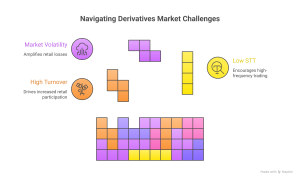
Retail losses in India’s derivatives market have reached crisis proportions—but not for the reasons most people assume. An examination of two decades of data from the National Stock Exchange of India and the Securities and Exchange Board of India shows that the real drivers were exploding trading volumes and a surge in retail participation, not the Securities Transaction Tax (STT). For nearly 18 years, STT on derivatives remained unchanged even as retail losses ballooned. A modest STT hike in 2023 slowed the growth of losses without denting volumes, underscoring its secondary role. The far sharper STT increase proposed for FY2026, however, marks a turning point—and will test, for the first time, whether transaction taxation can meaningfully curb speculative retail behavior without damaging market quality.
The empirical backdrop: volume and participation
Since the introduction of the Securities Transaction Tax (STT) in 2004, India’s equity derivatives market—dominated by the National Stock Exchange of India—has grown from a niche institutional market into the largest retail-driven derivatives ecosystem globally.
For nearly 18 years (FY2004–05 to FY2021–22):
- STT on equity derivatives remained unchanged
(futures ~0.01% on sell side; options ~0.05% on premium). - Annual derivatives turnover expanded from ₹24 lakh crore to ₹4,690 lakh crore.
- Retail participation rose from negligible levels to roughly 35% of activity.
This alone establishes an important baseline: the explosion in retail derivatives trading occurred in a flat-STT regime.
Retail losses: what the regulator found
STT RATE Vs DERIVATIVE TURNOVER Vs RETAIL LOSS
| Fiscal Year | STT (Futures / Options) | NSE Derivatives Turnover (₹ lakh crore) | Retail Participation (%) | Estimated Retail Net Loss (₹ lakh crore) |
| 2004–05 | 0.01% / 0.05% | 24 |
~0% |
~0 |
| 2007–08 | 0.01% / 0.05% | 170 | ~1% | ~0.05 |
| 2010–11 | 0.01% / 0.05% | 292 | ~3% | ~0.10 |
| 2013–14 | 0.01% / 0.05% | 382 | ~6% | ~0.15 |
| 2016–17 | 0.01% / 0.05% | 922 | ~12% | ~0.25 |
| 2018–19 | 0.01% / 0.05% | 1,880 | ~20% | ~0.35 |
| 2019–20 | 0.01% / 0.05% | 2,100 | ~23% | ~0.30 |
| 2020–21 | 0.01% / 0.05% | 3,060 | ~28% | ~0.60 |
| 2021–22 | 0.01% / 0.05% | 4,690 | ~35% | ~0.80 |
| 2022–23 | 0.0125% / 0.0625% | 6,200 | ~38–40% | ~0.40 |
| 2023–24 | 0.0125% / 0.0625% | 8,740 | ~40–42% | ~0.45* |
| 2025–26* | 0.05% / 0.15% | — | To be observed | To be observed |
* FY2023–24 loss extrapolated from SEBI trend disclosures.
* FY2025–26 reflects Budget-announced STT rates; participation, turnover and losses will be known ex-post.
The Securities and Exchange Board of India published a comprehensive study in 2023 analysing retail participation in equity derivatives. Its key findings were stark:
- ~90% of retail F&O traders incur net losses.
- Over FY2020–21 to FY2022–23, cumulative net losses to retail traders were ~₹1.8 lakh crore.
- Losses were persistent across market conditions and concentrated in short-dated index options.
Importantly, SEBI did not identify STT as a primary causal variable. Instead, losses were structurally linked to:
- Excessive trading frequency,
- Weekly index options with severe time decay,
- High leverage embedded in option payoffs,
- Behavioural biases amplified by app-based trading and influencer culture.
A simple decomposition: Why Losses Rose?
Retail losses can be decomposed as:
Retail Loss = Market Volume × Retail Share× Loss Rate per Trade
Between FY2019–20 and FY2022–23:
- Market volume nearly tripled.
- Retail share rose from ~23% to ~40%.
- Loss rate per trade remained structurally high, driven by product design and behaviour.
STT enters this equation only as a small component of transaction cost. It does not affect:
- Directional accuracy,
- Volatility forecasting,
- Option time decay (theta),
- Or the asymmetric payoff structure that disadvantages frequent option buyers.
Hence, STT is a second-order variable in explaining retail losses; volume and participation are first-order drivers.
What changed after the 2023 STT hike?
In April 2023, the government raised STT modestly on derivatives:
- Futures: 0.01% → 0.0125%
- Options (premium): 0.05% → 0.0625%
The market response was instructive:
- Volumes continued to rise sharply (FY2023–24 turnover hit ~₹8,740 lakh crore).
- Retail participation plateaued around ~40%.
- Growth in retail losses slowed, even though absolute losses remained large.
- STT collections increased materially.
This confirms the nature of STT as a frictional tool: it increases the cost of excessive churn but does not meaningfully deter participation or reduce aggregate volumes when applied in small increments.
Why the FY2026 STT hike is different?
The FY2026 budget proposes a step-change:
- Futures STT raised to 0.05% (roughly 5× the long-standing rate).
- Options STT raised to 0.15% on premium (roughly 3×).
This is the first time STT moves from the margins to the core of trading economics, especially for:
- High-frequency retail traders,
- Weekly index option strategies with thin expected margins,
- Short-holding-period speculative trades.
Unlike earlier tweaks, this hike is large enough to:
- Reduce trade frequency rather than merely raise costs,
- Alter the expected value of many retail strategies,
- Potentially compress volumes without proportionate loss of hedging activity.
Policy implications and the natural experiment ahead
For two decades, India’s experience showed that flat STT did not prevent explosive retail participation or rising losses. The 2023 hike demonstrated that small increases slow loss growth but do not alter market structure.
FY2026 creates a natural experiment:
- If volumes fall and retail losses decline without impairing liquidity, STT will have proven effective as a behavioural regulator.
- If activity migrates offshore or into informal channels, the limits of transaction taxation will be exposed.
- Either outcome will provide rare empirical evidence on whether transaction taxes can meaningfully shape speculative behaviour in ultra-liquid derivative markets.
Take away
Retail losses in Indian derivatives markets have been driven overwhelmingly by scale and participation, not by the level of STT. For most of the market’s history, STT remained constant while both volumes and losses surged. Modest increases in 2023 confirmed STT’s secondary, frictional role. The FY2026 hike, unprecedented in magnitude, will finally test whether transaction taxation can operate as a first-order policy lever—capable of reshaping behavior without damaging market quality.
#IndianDerivatives #RetailTraders #STT #RetailLosses #NSE #SEBI
#OptionsTrading #MarketRegulation #Budget2026 #FinancialMarkets